

A leaning cap, sinkholes opening in the lawn, soil bleeding into the water at the toe — a bulkhead in trouble announces itself, and every storm accelerates it. Jordan Marine Construction repairs vinyl, wood, and steel bulkheads across Greater Houston, Lake Conroe, Lake Livingston, Clear Lake, and the Texas Gulf Coast. We diagnose the actual cause of the failure — hydrostatic pressure, washout, or tie-back failure — and fix that, not just the symptom you can see.
Because we build complete bulkhead systems ourselves, we can repair any part of one: restoring deadmen and tie rods, replacing rotted or corroded wales and caps with through-bolted galvanized hardware, sealing joints that are washing out backfill, filling voids and sinkholes with compacted fill, and adding the drainage and toe protection that stop the failure from coming back. A targeted structural repair costs a fraction of replacement — and when it's aimed at the real cause, it lasts.
Request Your Free Estimate What does a bulkhead cost? See real per-foot prices from our 2026 projects →Our Bulkhead Repair Process
-
Inspection & Failure Diagnosis
We survey the wall face, cap, wales, tie-back system, and the ground behind the wall to find the real cause — washout, failed anchors, rot or corrosion, or hydrostatic pressure — and document it with photos before quoting anything.
-
Itemized Repair-vs-Replace Proposal
You get a clear, itemized scope separating must-fix structural work from cosmetic items, with honest guidance on whether repair or replacement is the smart money — and a CAD-drawn plan for larger repairs.
-
Tie-Back & Deadman Restoration
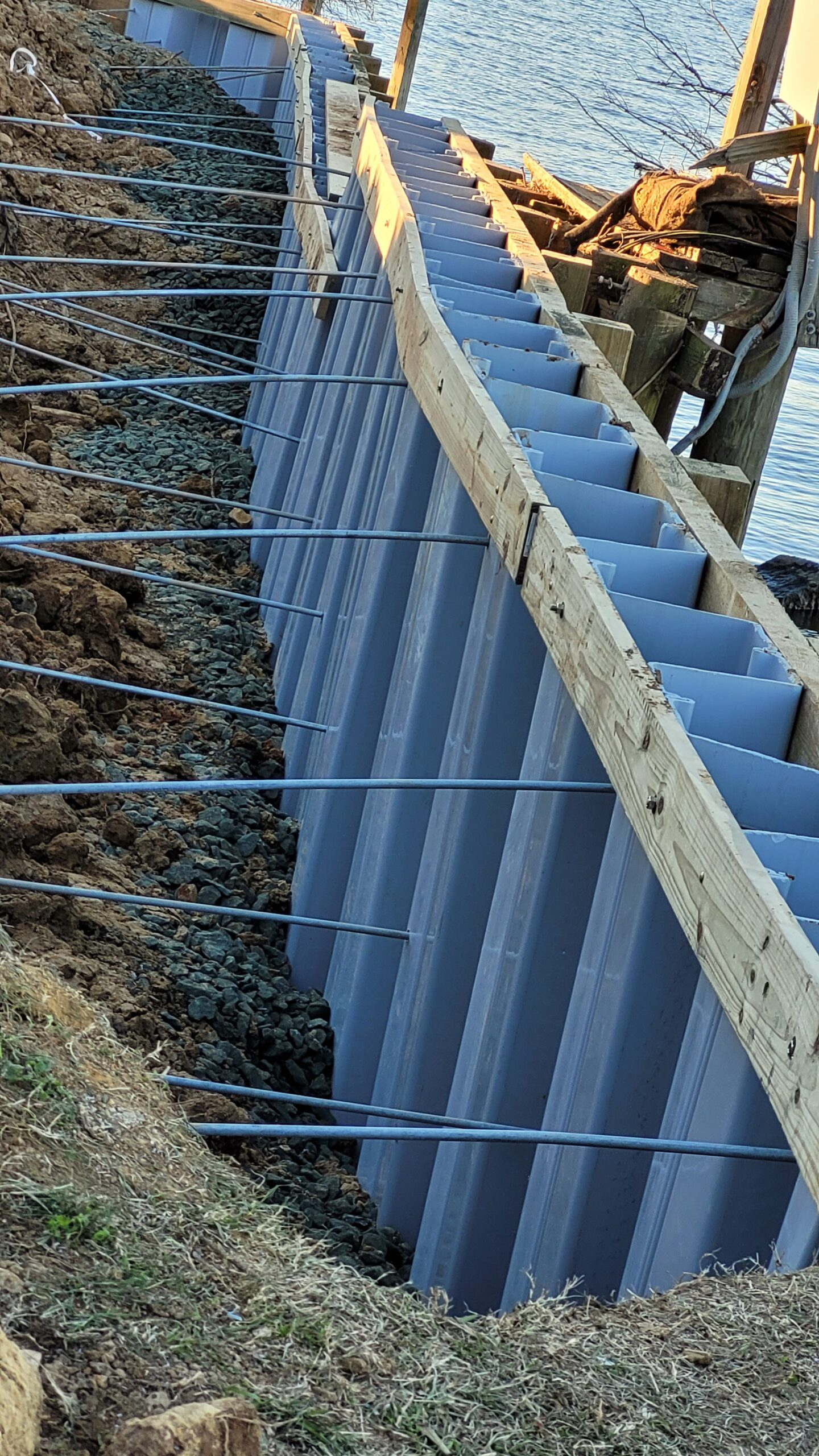
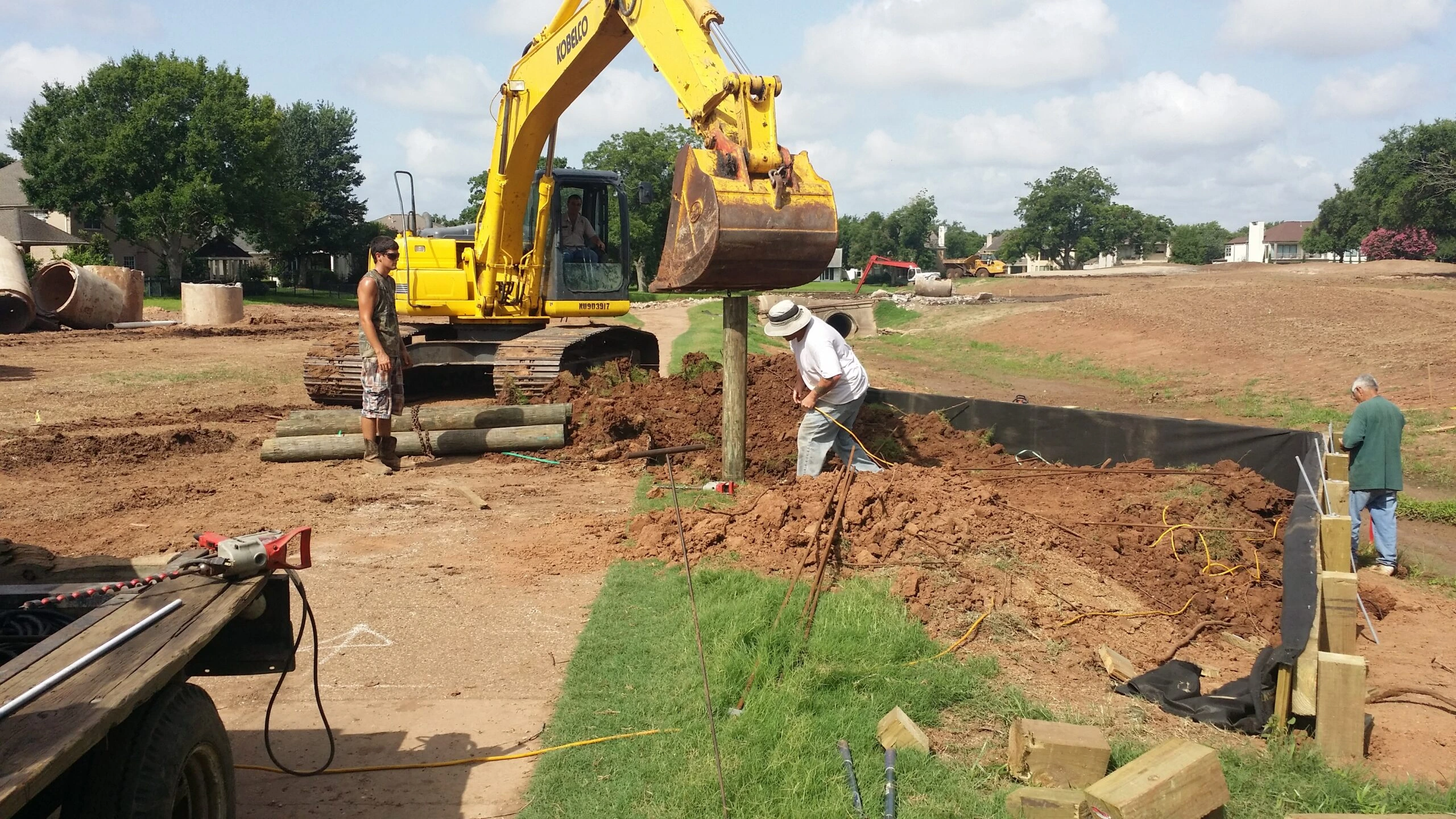
Failed anchors are the most common structural repair on older walls. We install new deadmen and solid galvanized tie rods with threaded ends, set in stable soil behind the failure plane, and draw the wall back toward plumb where conditions allow.
-
Cap, Wale & Sheet Repair
Cracked caps, rotted or corroded wales, and damaged sheets are replaced with environment-treated material, secured with through-bolts and countersunk galvanized fasteners — not the nails and spikes that fail in rough water.
-
Washout, Drainage & Toe Protection
We seal the joints bleeding your backfill into the lake, fill voids and sinkholes with compacted fill, relieve hydrostatic pressure with weep holes and filter fabric, and add a riprap toe apron where wake is undermining the base.
-
Grade, Cleanup & Walkthrough
Backfill is compacted, grade and sod restored, and the site left clean and ready to landscape. We walk the finished repair with you and flag anything worth watching down the road.
How We Repair Bulkheads
Repairs use the same standards as our new walls: timber pressure treated for its environment (.60 pcf CCA freshwater, 2.5 pcf CCA saltwater), solid galvanized tie rods with threaded ends to driven deadman anchors, through-bolted galvanized or stainless hardware on caps and wales, and proper drainage and compacted backfill to relieve the hydrostatic pressure that causes most failures. We repair vinyl, wood, and steel walls — and if a wall is genuinely past repair, we say so and price the replacement honestly.
How Bulkheads Actually Fail — and Why We Diagnose Before We Quote
Nearly every bulkhead failure we're called to traces back to one of three underground causes, and none of them is the symptom the owner noticed. Hydrostatic pressure is the first: Houston-volume rain saturates the soil behind a wall, and without working drainage that water pushes outward with enormous force after every storm. Washout is the second: backfill escaping through open joints or under the toe, hollowing voids that surface as sinkholes, settling patios, and low spots along the cap. Anchor failure is the third: tie rods and deadmen corroding or pulling loose, letting the wall rotate waterward a little further each season — which opens the joints and feeds the washout.
The visible evidence — a leaning wall, a cracked cap, holes in the lawn — is late-stage output of one of those processes. Patching the symptom without treating the cause is why so many 'repaired' bulkheads fail again within a couple of years, and it's why our process starts with a genuine inspection of the wall face, cap, wales, anchor system, and the ground behind the wall, documented with photos, before we quote anything.
That diagnosis-first approach usually saves money. A wall with failed tie-backs but sound sheeting needs anchor restoration, not replacement. A wall bleeding backfill through one bad joint needs that joint sealed and the voids filled. We only recommend replacement when the wall is genuinely beyond economic repair — and when we do, we can show you exactly why.
Repairs That Restore Structure, Not Just Appearance
Tie-back and deadman restoration is the most common structural repair on older walls and the highest-value one: we install new deadman anchors in stable soil behind the failure plane, connect them with solid galvanized tie rods with threaded ends, and draw the wall back toward plumb where conditions allow. Done correctly, it adds decades to a wall whose sheeting is still sound.
Cap and wale replacement renews the wall's backbone. Rotted, warped, or corroded members come off and are rebuilt with timber treated to the environment — .60 pcf CCA freshwater, 2.5 pcf CCA saltwater — secured with through-bolts and countersunk galvanized fasteners rather than the nails and spikes that let caps lift and warp in rough water. Damaged sheets are repaired or replaced in place, in vinyl, timber, or steel.
Then we fix the soil side, because that's where the failure started: joints and penetrations that were bleeding backfill get sealed, voids and sinkholes get filled with compacted material, weep holes with filter fabric relieve the hydrostatic pressure, and where boat wake or current is scouring the base, a properly sized riprap toe apron stops the undermining. Treat all three mechanisms — pressure, washout, anchoring — and the repair holds. Treat one, and you'll be calling someone back after the next big rain.
Lake Walls and Coastal Walls Fail Differently — We Repair Both
On the freshwater lakes — Conroe, Livingston, Houston — bulkheads fail mostly from hydrostatic pressure and washout after major rain events, and older communities are full of timber walls due for cap, wale, and anchor work. Marine borers aren't the enemy there; time, rot, and drainage are. On Clear Lake, Kemah, Seabrook, and Galveston Bay, brackish water accelerates steel corrosion and demands 2.5 pcf CCA treatment on any timber component, and walls take real wave and surge loading in tropical weather.
We repair across that whole range, and we handle the permitting layer where repairs require it — SJRA on Lake Conroe, TRA on Lake Livingston, City of Houston on Lake Houston, USACE Galveston District and the Texas GLO on the coast. Active failures get priority scheduling: a wall that has started to move is a structure on a clock, and every storm accelerates it.
If your wall is showing early symptoms — a small depression behind the cap, a hairline crack, a corner that no longer lines up with the neighbor's wall — an inspection now is dramatically cheaper than a rebuild later. We assess honestly, and if the wall is fine, we'll tell you that too.
The Standards Your Repaired Wall Should Meet
A repair is only as good as the standard it restores the wall to. On Lake Houston, bulkhead construction is codified in the City of Houston Building Code, Chapter 62 — and those specifications are a useful benchmark for what any sound wall in our region should look like, from pile embedment to anchor sizing to galvanized hardware. When we restore a wall, these are the numbers we're restoring it toward.
City of Houston — Lake Houston (Building Code, Chapter 62)
Bulkhead designs on Lake Houston must bear the seal of a Texas-licensed professional engineer (§6201.1), and permitted work is inspected before and after construction. The structural minimums below are what a healthy wall looks like — and what failed components are rebuilt to.
- §6204.2.1 Wood-bulkhead piles: minimum 5 in. diameter, embedded at least 5 ft into firm soil, spaced no more than 6 ft on center.
- §6204.2.2 Wales: minimum 3×8 lumber — two members for walls up to 5 ft above grade, three above that — fastened with ½ in. galvanized bolts, washers, and nuts.
- §6204.2.4 Deadmen / tie-backs: minimum 8 in. × 4 ft, embedded 30 in. into firm soil, tied with ½ in. galvanized cable or rod, a maximum of three piles per anchor.
Sources & Official References
Specifications above are summarized from the referenced codes as of July 2026 and are provided for planning. Every repair is performed to the current requirements of the authority having jurisdiction.
Related Projects
Where We Build Bulkhead Repair
We build bulkhead repair for waterfront communities across Greater Houston, Lake Conroe, Lake Livingston, and the Texas Gulf Coast. A few of the areas we serve:
Don't see your area? View all service areas or contact us.
Bulkhead Repair FAQs
What are the warning signs my bulkhead is failing?
Sinkholes or depressions in the lawn behind the wall, the wall leaning or bowing waterward, cracks in the cap, gaps opening between sheets, and soil washing into the water at the toe after rain. Any of these justifies an inspection — early repairs are dramatically cheaper than late ones.
Why does my lawn keep sinking behind the bulkhead even after I fill it?
Because the soil is escaping through an open joint or under the toe of the wall, and filling the hole just feeds the lake more of your yard. The lasting fix seals the escape path, fills the voids, restores the tie-backs, and adds drainage — all in one mobilization, so you only pay for it once.
Is it cheaper to repair or replace my bulkhead?
If the sheeting is sound, repair is almost always far cheaper — tie-back restoration, cap and wale work, and washout sealing each cost a fraction of a new wall. If the sheeting itself is failing wall-wide, replacement is the better long-term value. We inspect first and show you the evidence either way.
Do you repair vinyl, wood, and steel bulkheads?
Yes, all three. We build complete wall systems in all three materials, so our repair recommendation isn't biased toward the one product a crew happens to carry — and where a failing wall should transition to a different material, we can do that too.
How fast can you respond to a wall that's actively failing?
Active failures are on a clock — every rain and every wake works on the breach. We prioritize them for inspection and stabilization to stop ongoing loss while the permanent repair is scheduled. Contact us right away, with photos if possible.
How much does bulkhead repair cost?
It depends entirely on the failure mode — tie-back restoration, cap and wale work, and washout sealing are each a fraction of replacement cost. That's why we diagnose before quoting: the repair aimed at the actual cause is almost always the cheapest path that actually lasts. Estimates are free and itemized.
Can you repair just a section of my bulkhead?
Yes, when the failure is localized — one washed-out joint, a run of failed cap, a few damaged sheets. We tie the repaired section into the sound wall correctly. If the inspection shows the same failure developing wall-wide, we'll show you the evidence and let you decide between phased repair and comprehensive work.
Is foam injection a permanent fix for sinkholes behind a bulkhead?
On its own, no. Foam can fill voids and seal leaks quickly, but it doesn't restore the anchoring that holds a wall plumb — if the tie-backs have failed, foam hides the cause for a season. Our repairs treat the structure and the soil together: anchors, sealed joints, compacted fill, and drainage, so the fix lasts instead of buying a few months.
Do I need a permit to repair my bulkhead?
Often, yes — it depends on the waterbody and the repair scope. Like-for-like maintenance is treated differently from structural work in most jurisdictions, and Lake Houston bulkhead work involves the City of Houston permit process. We know where each authority draws the line and handle whatever process your repair requires.
Will insurance cover my bulkhead repair?
It depends on your policy and the cause — sudden storm damage is treated differently from gradual deterioration, and many policies exclude bulkheads unless specifically added. We document the condition and scope clearly with photos, which supports claims where coverage exists.
How long does a bulkhead repair take?
Targeted repairs — anchors, caps, void filling — are typically completed in days once mobilized. Larger stabilizations run longer depending on wall length and access. Active failures are stabilized first to stop ongoing loss while the permanent repair is scheduled.
Related Services
.webp)
Get a Free Bulkhead Repair Estimate
Tell us about your project and we'll provide a detailed, no-obligation estimate. Serving Greater Houston, Lake Conroe, Lake Livingston, and the Texas Gulf Coast.