

When a bulkhead is past saving, the replacement is your one chance to get the next forty years right — and not all bulkheads are created equal. Jordan Marine Construction replaces failing bulkheads across Greater Houston, Lake Conroe, Lake Livingston, Clear Lake, and the Texas Gulf Coast with complete engineered wall systems: sheeting driven to engineered embedment, deadman anchors set in stable soil, solid galvanized tie rods with threaded ends, and hardware that is galvanized or stainless throughout — never nails and spikes where structure is on the line.
We are a licensed, insured marine contractor that builds in vinyl, treated timber, and steel, so our recommendation follows your shoreline, not a product line. Every replacement is a complete package from start to finish — 3D design and CAD estimate, engineering, permitting, demolition and haul-off of the old wall, driving, backfill, and a final grade left clean and ready to landscape.
Request Your Free Estimate What does a bulkhead cost? See real per-foot prices from our 2026 projects →Our Bulkhead Replacement Process
-
Inspection & Honest Verdict
We inspect the existing wall, tie-backs, and the ground behind it. If a repair will genuinely buy you years, we say so — we only recommend replacement when the wall is truly beyond economic repair, and we show you why.
-
3D Design & CAD Estimate
You see the new wall before we build it: a CAD-drawn design with wall line, heights, tie-back layout, and material options priced side by side in a clear, itemized estimate.
-
Engineering & Permitting
Sheet material, embedment, wales, and deadman anchoring are engineered to your retained height and soil — sealed by an engineer where the authority requires it — and we run the permit with SJRA, TRA, City of Houston, or USACE/GLO.
-
Demolition or Build-in-Front
Where conditions allow, we drive the new wall just waterward of the old one and tie it back over the old wall line — saving your yard from full excavation. Otherwise we demolish, remove, and haul off the failed wall.
-
Drive, Anchor & Backfill
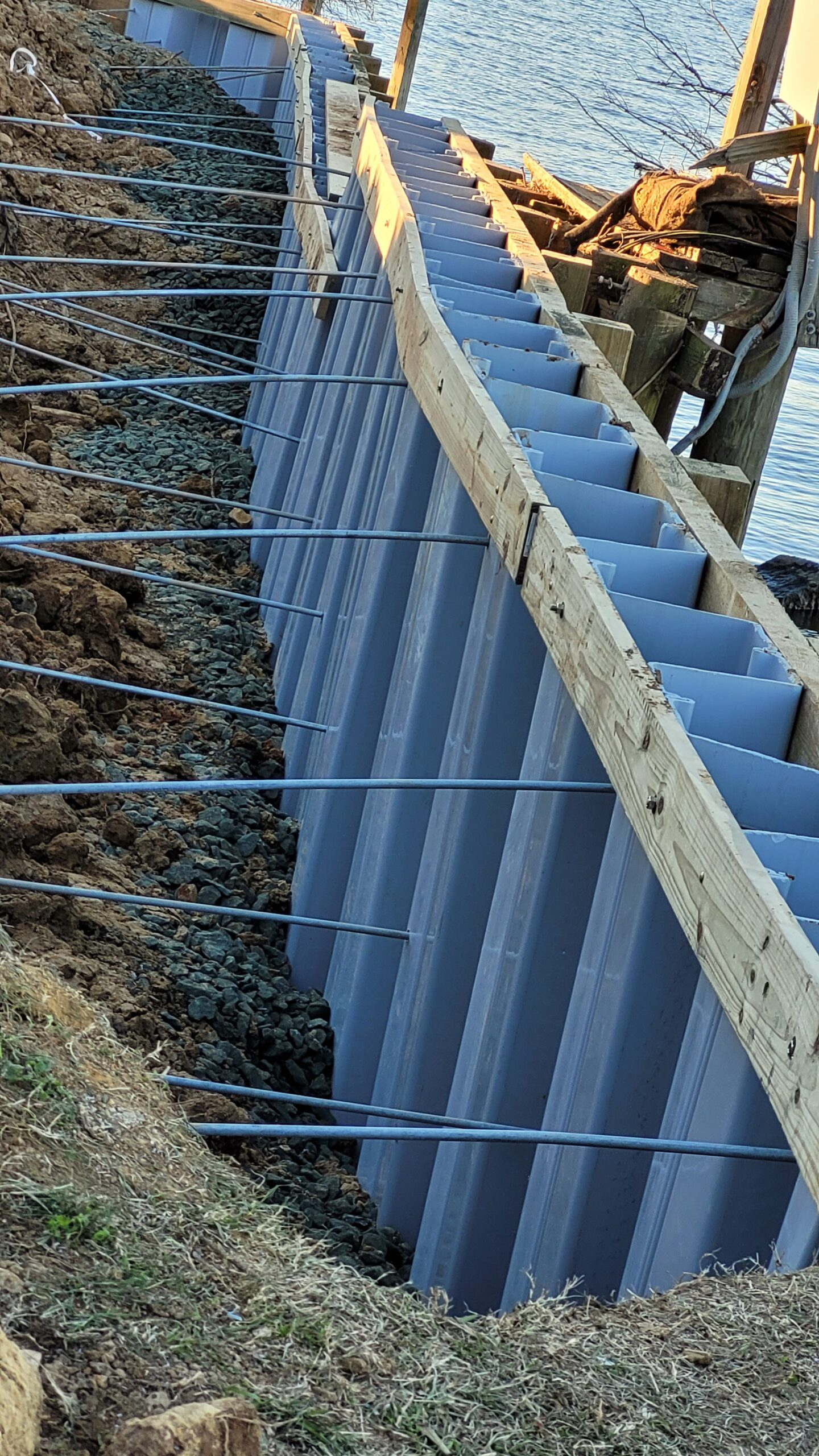
New sheeting is driven to engineered embedment, wales are through-bolted with galvanized hardware, deadmen are driven and secured with solid galvanized tie rods with threaded ends, and backfill goes in compacted in lifts.
-
Grade, Cleanup & Walkthrough
Every job is graded out and ready to landscape, with streets and driveways kept clean throughout. We walk the finished wall with you before we call it done.
Materials & Treatment Specifications
We replace bulkheads in vinyl sheet piling, treated timber, and steel — engineered to the retained height and hydrostatic loads at your site. Timber is pressure treated for its actual environment: .60 pcf CCA for freshwater lakes like Conroe and Livingston, 2.5 pcf CCA for saltwater and brackish exposure. Deadman anchors are secured with solid galvanized tie rods with threaded ends and nuts — not cable shortcuts — and caps and wales are secured with through-bolts and countersunk galvanized fasteners rather than nails or spikes, for strength and to prevent warping and pull-up in rough water.
Not All Bulkheads Are Created Equal: Questions to Ask Before You Hire
Two replacement bulkheads can look identical from the water the day they're finished and have completely different lifespans, because everything that determines how long a wall lasts is buried or underwater by the afternoon of the last day. Before you hire any contractor to replace your bulkhead — including us — there is a short list of questions worth asking, and the answers separate a forty-year wall from a fifteen-year one.
Ask whether the wall is anchored with deadmen, what they consist of, and how they're installed. A wall without real anchors rotates waterward no matter how strong the sheeting is. Ask what connects the wall to those anchors: solid galvanized tie rods with threaded ends and nuts hold and stay adjustable for decades; cables and rebar shortcuts corrode, stretch, and let go. Ask what hardware is used on the caps and wales — through-bolts and countersunk galvanized lags, or the nails and spikes that pull loose in rough water and let caps warp and lift. Ask the treatment retention of the timber: .60 pcf CCA is the freshwater standard, 2.5 pcf CCA for saltwater, and anything less is landscaping lumber in the wrong job. Ask how deep the pilings and sheeting are driven and how that number was arrived at. And ask whether the wall's specifications are engineered — on Lake Houston, the City of Houston Building Code requires bulkhead designs to bear the seal of a Texas-licensed professional engineer.
Those are the questions. Our answers: deadmen driven and secured on every installation, solid galvanized tie rods with threaded ends, through-bolted and countersunk galvanized hardware throughout, timber treated to its actual environment, embedment engineered from your retained height and soil rather than copied from the neighbor's wall, and engineering and permitting handled in-house on every project. That standard is the whole reason to replace a wall once instead of twice.
Build-in-Front Replacement: Saving Your Yard and Your Budget
The single biggest cost and disruption question in a bulkhead replacement is whether the old wall has to come out first. Full demolition means excavating the bank, which means the lawn, irrigation, landscaping — sometimes the patio — between the wall and the deadman line becomes part of the project. Where conditions allow, we avoid all of it by driving the new wall directly in front of the failing one, tying it back over the old wall's line to new anchors, and capping the assembly as one finished edge.
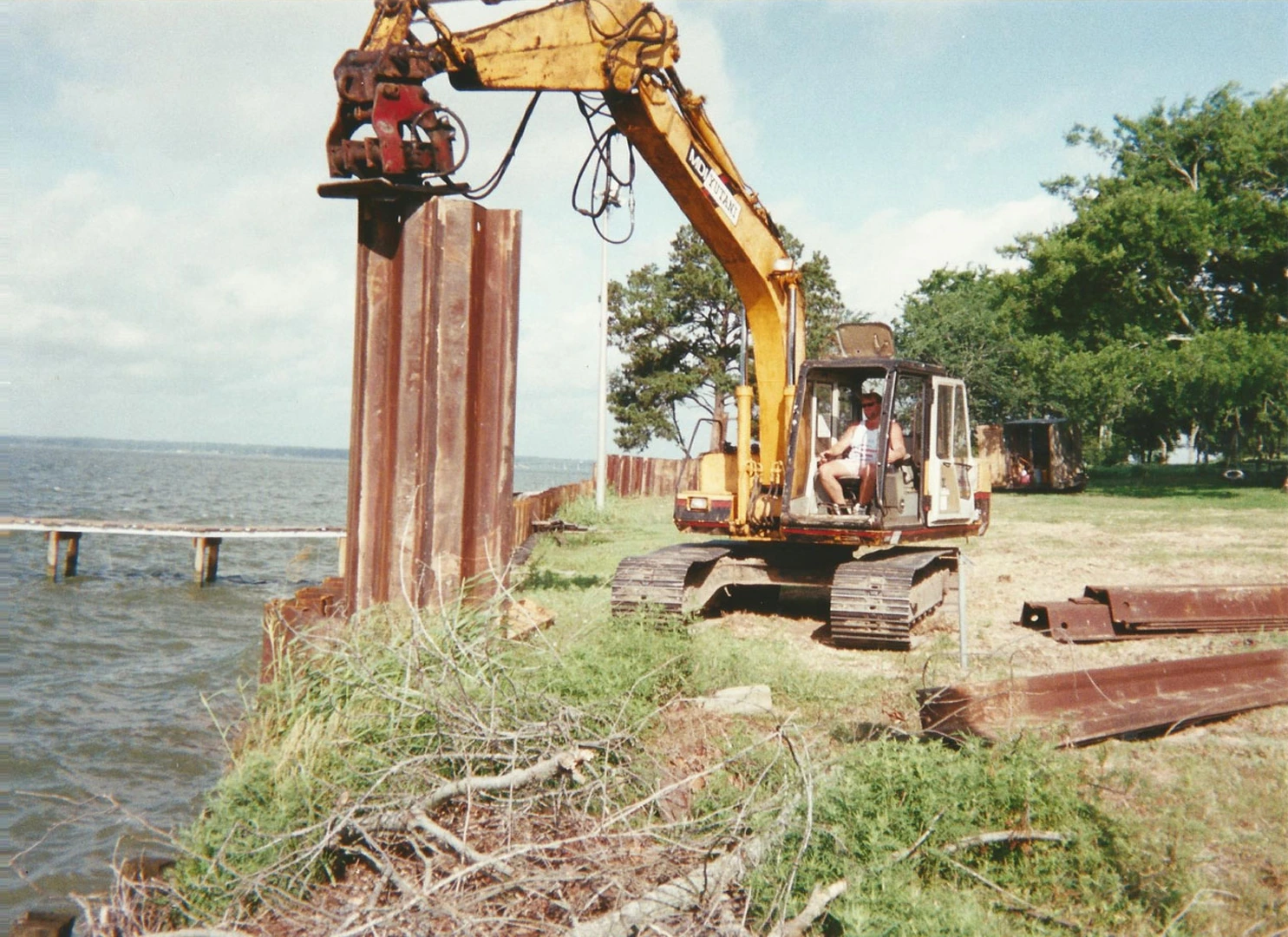
Build-in-front isn't always available — it costs a few inches of waterfront, the controlling authority has to approve the new wall line, and a badly rotated old wall can be in the way — but when it works, it is dramatically less invasive and usually less expensive. It's one of the first things we evaluate at the site visit, and because we drive our own sheeting from barge and land, we can execute it on shorelines that defeat contractors who rent their driving capability.
When the old wall does have to come out, we handle the full sequence ourselves: demolition, haul-off, any import fill the bank needs, driving and anchoring the new wall, compacted backfill in lifts, and final grading. One accountable crew from the first inspection to the last pass of the grade — with the job site, driveway, and street kept clean the whole way through.
See the New Wall Before We Build It: 3D Design & CAD Estimates
A bulkhead replacement is a significant investment, and you shouldn't have to make it from a number scrawled on a business card. We design replacement walls in CAD and can model your new shoreline in 3D — wall line, cap height, corners and returns, steps and dock tie-ins — so you see exactly what you're buying before a sheet is driven. The same drawings become the permit set, which is why our applications move through SJRA, City of Houston, and coastal review without redesign rounds.
The estimate that comes with it is itemized: demolition or build-in-front, sheeting material and footage, anchoring, backfill, and restoration priced as line items, with material options — vinyl, timber, steel — priced side by side where your site allows a choice. You can compare bids apples to apples, phase work when it makes sense, and know exactly what standard you're getting at each price. Estimates are free.
Finished Means Graded, Restored, and Ready to Landscape
A replacement isn't done when the last sheet is driven — it's done when the shoreline behind it is whole again. Backfill goes in compacted in lifts, not dumped in one push that settles for the next two years. Grade is restored and finished smooth, sod goes back where it was disturbed, and the transition into neighboring walls on both property lines is tied in and sealed so the shoreline reads as one continuous edge.
Upgrades are easiest to build in at replacement time: a full-dimension treated top cap that won't warp or pull up in rough water, stainless fasteners in brackish exposure, dock and ladder tie-ins, lighting, and a riprap toe apron where wake works at the base of the wall. We'll walk through what's worth it for your site — and what isn't — during design.
Local Codes & Engineering Specifications We Replace To
A replacement bulkhead is permitted and inspected like new construction, and the authority that controls your waterbody sets real, enforceable specifications. On Lake Houston they're codified in the City of Houston Building Code, Chapter 62 — including the requirement that bulkhead designs bear the seal of a Texas-licensed professional engineer. On Lake Conroe, bulkheads run through the San Jacinto River Authority; coastal work adds the U.S. Army Corps of Engineers, Galveston District. These are the standards our replacement walls are engineered to.
City of Houston — Lake Houston (Building Code, Chapter 62)
Every bulkhead must be designed by and bear the seal of a Texas-licensed professional engineer (§6201.1). A City of Houston Bulkheads Permit (HPWCODE1004) plus an annual license are required, and the site is inspected before the permit issues and again after construction.
- §6204.2.1 Wood-bulkhead piles: minimum 5 in. diameter, embedded at least 5 ft into firm soil, spaced no more than 6 ft on center — and 1 in. larger in diameter and 1 ft deeper for every 5 ft of exposed height.
- §6204.2.2 Horizontal members (wales): minimum 3×8 lumber — two members for walls up to 5 ft above grade, three above that — fastened with ½ in. galvanized bolts, washers, and nuts.
- §6204.2.4 Anchors (deadmen / tie-backs): minimum 8 in. × 4 ft, embedded 30 in. into firm soil, tied with ½ in. galvanized cable or rod, a maximum of three piles per anchor.
- §6204.3 Concrete bulkheads: minimum 2,500 psi mix embedded 36 in. into firm soil, no more than 30 in. above grade; reinforced with No. 3 rod at 18 in. on center each way (§6204.3.2).
- §6204.4 Steel sheet-pile bulkheads: ASTM A570, minimum No. 12 gauge, minimum 12 in. finished pile width, embedded at least 4 ft into firm soil.
Lake Conroe — San Jacinto River Authority (SJRA)
No person may construct or maintain a private bulkhead on Lake Conroe without an SJRA permit — including replacements. Applications require a current boundary survey by a Registered Professional Land Surveyor with the proposed structure located on it, and all dredging, filling, and bulkheading must be performed in accordance with the permits of the U.S. Army Corps of Engineers, Galveston District.
Sources & Official References
Specifications above are summarized from the referenced codes as of July 2026 and are provided for planning. Every project is engineered and permitted to the current requirements of the authority having jurisdiction.
Related Projects
Where We Build Bulkhead Replacement
We build bulkhead replacement for waterfront communities across Greater Houston, Lake Conroe, Lake Livingston, and the Texas Gulf Coast. A few of the areas we serve:
Don't see your area? View all service areas or contact us.
Bulkhead Replacement FAQs
How do I know my bulkhead needs replacement instead of repair?
Widespread rot or corrosion in the sheeting, multiple failed tie-backs, a wall leaning beyond what anchor restoration can recover, or repeated failures after past repairs all point to replacement. We inspect first and tell you honestly which side of the line your wall is on — many walls we look at only need repair.
Can you build the new bulkhead without tearing up my yard?
Often, yes. Where conditions allow we drive the new wall directly in front of the failing one and tie it back over the old wall's line, avoiding full excavation of the bank. It's a major cost and disruption saver, and we assess it at the site visit.
Vinyl, wood, or steel — what should I replace it with?
It depends on your retained height, wave exposure, water chemistry, and budget. Vinyl is the corrosion-proof default on most residential lake shorelines, timber is the budget-smart traditional choice, and steel is for tall walls and high-energy sites. We build all three, so the advice follows your site — and we price options side by side.
Do you handle the permit for a replacement bulkhead?
Yes. Replacement walls are permitted like new construction — SJRA on Lake Conroe, TRA on Lake Livingston, City of Houston on Lake Houston, USACE Galveston District and the Texas GLO on the coast. We prepare the drawings and run the process end to end.
Will you match my neighbors' bulkheads?
Yes. We routinely tie new walls into the adjacent bulkheads on both property lines, matching heights and sealing the joints so the shoreline reads as one continuous, protected wall.
How much does bulkhead replacement cost per foot?
Cost per linear foot depends on wall height and embedment, material (timber, vinyl, steel), whether we can build in front of the old wall or must demolish it, access, and restoration scope. Vinyl typically lands between timber and steel for the same wall. We provide free itemized per-foot estimates after assessing your bank, with material options priced side by side.
How long does a bulkhead replacement take?
Most residential replacements are measured in weeks once permitting clears — driven by wall length, access, and whether the old wall comes out. Permitting timelines vary by authority (SJRA, TRA, City of Houston, USACE/GLO). We give you a firm schedule with the estimate and keep the site clean and workable throughout.
Can you replace my wood bulkhead with vinyl or steel?
Yes — replacement is the natural time to change materials. Most failing timber walls on residential lake shorelines are replaced with vinyl for its corrosion- and borer-proof service life; tall or high-energy walls step up to steel. We build all three and will recommend based on your site, not a product line.
What are deadmen and why do they matter?
Deadmen are buried anchors set in stable soil well behind the wall, connected to it with tie rods. They're what keep a bulkhead vertical against the soil and water pressure trying to push it over — most 'wall failures' are actually anchor failures. We drive and secure deadmen on every wall we build, connected with solid galvanized tie rods with threaded ends.
Do I lose waterfront if you build the new wall in front of the old one?
A few inches — the thickness of the new sheeting plus its offset from the old face. For most owners that trade is easily worth avoiding excavation of the yard, and the controlling authority reviews and approves the new wall line as part of permitting.
Can I add a dock, ladder, or lighting during the replacement?
Yes, and it's the best time to do it — tie-ins are engineered into the wall instead of bolted on later. We build docks, boat lifts, and boat houses in-house, so the whole waterfront can be designed and permitted as one project.
Related Services
Get a Free Bulkhead Replacement Estimate
Tell us about your project and we'll provide a detailed, no-obligation estimate. Serving Greater Houston, Lake Conroe, Lake Livingston, and the Texas Gulf Coast.