

A failing seawall puts everything behind it at risk — your yard, your foundation, your dock, and your property value. Jordan Marine Construction repairs, stabilizes, and replaces failing seawalls across Greater Houston, Lake Conroe, Lake Livingston, Clear Lake, and the Texas Gulf Coast. We assess the real cause of the failure, not just the symptom, and fix it to last.
As a licensed, insured marine contractor, we handle everything from targeted repairs — tie-back and deadman restoration, cap and whaler replacement, sinkhole and void backfilling, panel and sheet repair — to full seawall replacement when a wall is beyond saving. We work on steel, vinyl, and timber seawalls and recommend the most cost-effective path honestly.
Request Your Free Estimate What does a bulkhead cost? See real per-foot prices from our 2026 projects →Our Seawall Repair Process
-
Inspection & Failure Report
We survey the wall face, cap, tie-back system, and the ground behind the wall to find the actual cause — undermining, tie-back failure, corrosion, washout, or hydrostatic pressure — and document it with photos before quoting a fix.
-
Transparent Repair vs. Replacement Proposal
You get a clear, itemized scope with options — targeted stabilization, tie-back or cap work, drainage upgrades, or full replacement — plus timelines and honest guidance on the most cost-effective path that will actually last.
-
Permitting
We coordinate any required permits with the controlling authority — SJRA on Lake Conroe, TRA on Lake Livingston, City of Houston on Lake Houston, and USACE Galveston District / Texas GLO on the coast — and keep you informed at every step.
-
Stabilization & Structural Repair
We restore tie-backs and deadmen, replace cracked caps and rotted or corroded whalers, fill voids and sinkholes with compacted backfill, and seal or replace damaged panels and sheets to bring the wall back to plumb where conditions allow.
-
Drainage & Toe Protection
We relieve the hydrostatic pressure that drives most failures with weep holes and filter fabric, and — where boat wake or current is eroding the base — add a properly sized riprap toe apron to stop scour and undermining.
-
Backfill, Cleanup & Final Walkthrough
We compact behind the wall, restore grade and sod, demobilize equipment, and walk the finished shoreline with you — including maintenance recommendations to keep it performing.
How We Repair Seawalls
Repairs use corrosion-resistant tie-back and anchor systems, treated or composite whalers, and proper drainage and backfill to relieve the hydrostatic pressure that causes most failures. Where a wall is too far gone, we replace it with an engineered steel, vinyl, or timber bulkhead sized to the site. We diagnose the cause first so the repair actually lasts.
How Seawalls Actually Fail — and Why the Diagnosis Comes First
Almost every seawall failure traces back to one of three root causes, and none of them is the crack you can see. The first is hydrostatic pressure: water trapped in the soil behind the wall with nowhere to drain, pushing outward with enormous force after every heavy rain — and Houston gets heavy rain. The second is loss of backfill: soil washing out through joints, cracks, or under the wall's toe, hollowing out voids that eventually appear as sinkholes, settling patios, and depressions along the cap. The third is anchor failure: tie-back rods and deadmen corroding or pulling loose, letting the wall rotate waterward a little more each season.
The visible symptoms — a leaning wall, a cracked cap, gaps opening at the joints, low spots in the lawn — are late-stage evidence of one of those processes. Patching the symptom without treating the cause is why so many 'repaired' seawalls fail again within a few years. Our repair process begins with a genuine diagnosis: we inspect the wall face, cap, tie-back system, and the ground behind the wall to determine which failure mechanism is at work before we quote anything.
That diagnostic-first approach usually saves money. A wall with failed tie-backs but sound sheeting doesn't need replacement — it needs anchor restoration. A wall losing backfill through one bad joint needs that joint sealed and the voids filled, not a new wall. We only recommend replacement when the structure is genuinely beyond economic repair, and when we do, we can show you why.
Repair Methods: Tie-Backs, Void Filling, Caps, Whalers & Panel Repair
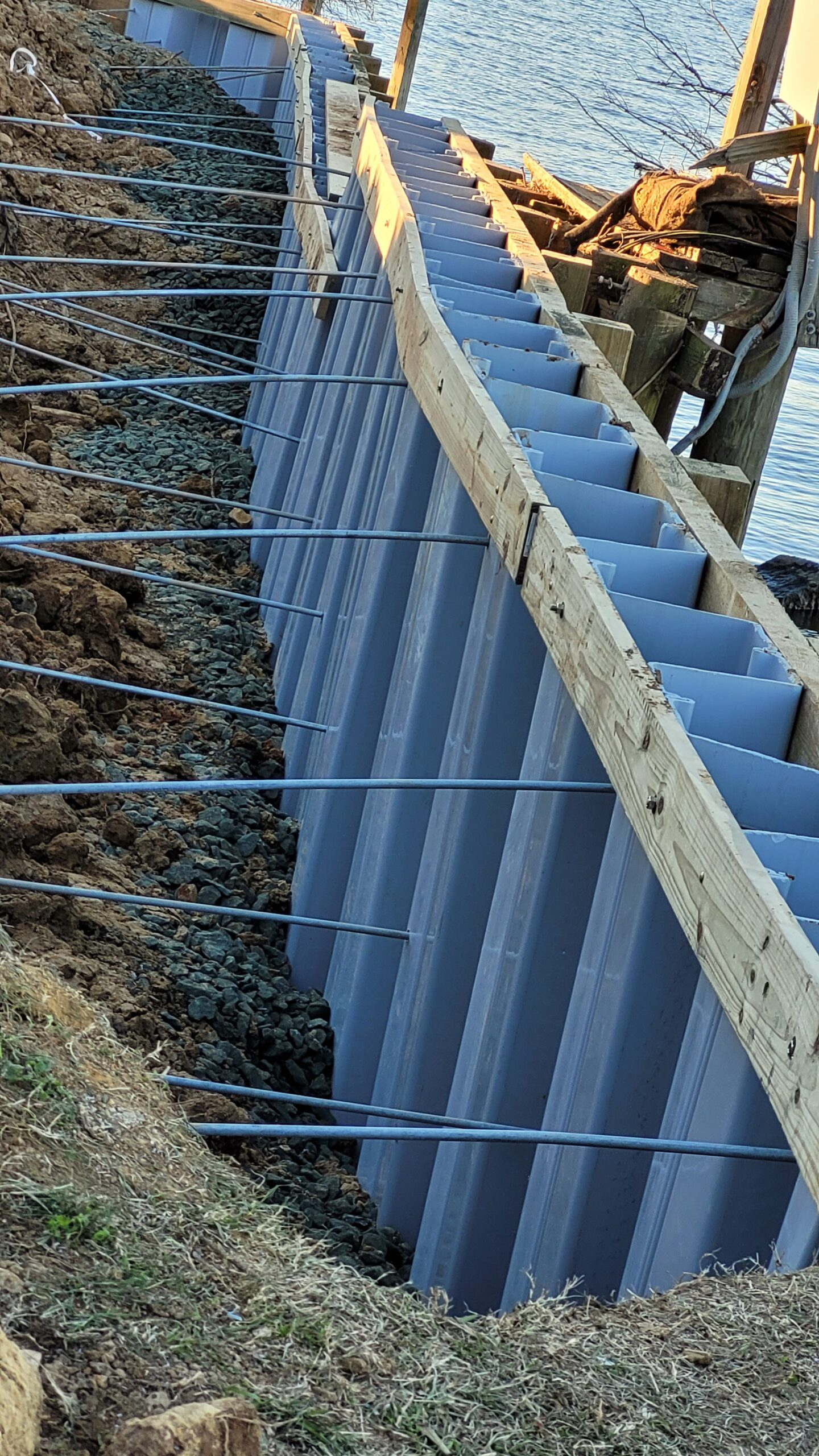
Tie-back and deadman restoration re-anchors a rotating wall: we install new corrosion-resistant rods and anchors set in stable soil behind the failure plane, then draw the wall back toward plumb where conditions allow. This is the single most common structural repair on older walls, and done correctly it adds decades of service.
Void filling and backfill restoration addresses washout. We fill sinkholes and voids behind the wall, seal the joints or penetrations that let soil escape, and restore compacted grade — paired with drainage improvements that relieve the hydrostatic pressure that drove the failure. Cap and whaler replacement renews the wall's structural backbone: cracked concrete caps and rotted or corroded whalers are removed and rebuilt with treated or composite members and hot-dip galvanized hardware.
Where individual panels or sheets are damaged — cracked concrete, holed steel, rotted timber sections — we repair or replace them in place. And on steel walls with waterline corrosion, we assess remaining section and advise honestly whether repair, partial replacement, or a new wall in front of the old one is the smart money. Because we build steel, vinyl, and timber walls ourselves, our recommendation isn't biased toward any one fix.
Serving Lake Conroe, Galveston Bay, and Everything Between
Seawall problems look different across our region. On Lake Conroe and Lake Livingston, freshwater walls fail mostly from hydrostatic pressure and washout after big rain events, with borer-free but rot-prone timber walls common in older communities. On Galveston Bay, Clear Lake, Kemah, and Seabrook, brackish water accelerates steel corrosion and demands 2.5 CCA treatment on any timber component — plus walls take real wave and surge loading in tropical weather.
We repair all of it, and we handle the permitting layer too: repairs and replacements can require review by the SJRA on Lake Conroe, the TRA on Lake Livingston, the City of Houston on Lake Houston, and the USACE Galveston District and Texas GLO on the coast. Active failures get priority scheduling — a wall that has started to move is a structure on a clock, and every storm accelerates it.
If your wall is showing early symptoms — small depressions in the lawn, hairline cap cracks, a gate that no longer lines up — an inspection now is dramatically cheaper than a rebuild later. We assess honestly, and if the wall is fine, we'll tell you that too.
What a Professionally Engineered Repair Actually Buys You
The cheapest seawall repair is the one that fixes the actual cause the first time. Targeted structural work — restoring tie-backs, rebuilding a cap, sealing the joint that's bleeding your backfill into the lake — costs a fraction of tearing out and replacing a wall, and when it's aimed at the real failure mechanism it lasts. That is the whole argument for diagnosis-first: money spent patching symptoms is money spent twice.
A sound wall protects far more than the dirt directly behind it. Once soil starts escaping or a wall starts rotating, the damage cascades — patios settle, sod sinks, sprinkler and drain lines shear, and the dock, boat lift, and even the house foundation lose the ground they depend on. Stabilizing the wall early stops that chain reaction while it is still cheap to stop.
Because we are a licensed, insured marine contractor that builds steel, vinyl, and timber walls — and drives our own piling from barge and land — our recommendation is not steered toward the one product a crew happens to carry. We work out the most durable fix for your site and your budget, show you why, and stand behind the result. Estimates are free and itemized, so you can phase the work when it makes sense.
Drainage, Weep Holes, and Toe Protection: Fixing the Cause, Not Just the Crack
Most seawalls in our region don't fail because the wall was weak — they fail because water and scour went to work on the soil around it. Two details fix that, and they are the ones budget repairs skip. The first is drainage: hydrostatic pressure from rain-saturated soil behind a wall is one of the leading causes of bowing and cracking in Houston's clay. We relieve it with weep holes backed by filter fabric, so trapped water drains out while the backfill stays in.
The second is toe protection. Where boat wake, waves, or current wash at the base of a wall, they carve out the bottom in front of it and undermine the whole structure from below — the classic reason a wall suddenly leans after years of sitting fine. A properly sized riprap apron over bedding stone absorbs that energy and stops the scour. Not every quiet canal needs it, but open-fetch bayfront and high-wake locations usually do, and we size the stone and apron to the site.
Pair those with sealed joints and compacted backfill and you have treated all three failure mechanisms — pressure, washout, and undermining — instead of just the one you could see. That is the difference between a repair that holds and one you are calling us back about after the next big rain.
Types of Seawall Projects We Repair Across Greater Houston
Seawall problems wear a different face in every part of our service area, and the right repair changes with them. In the residential canals of Kemah, Seabrook, League City, and Nassau Bay, we stabilize vinyl and timber bulkheads that fail from washout and tired tie-backs. On the bayfront around Clear Lake, Galveston Bay, and Gulf-influenced shorelines, brackish water accelerates steel corrosion and walls take real wave and surge loading — so 2.5 CCA treatment on any timber component and corrosion-resistant hardware are not optional.
On the lakes — Conroe, Houston, and Livingston — freshwater walls fail mostly from hydrostatic pressure and washout after big rain events, and older communities are full of rot-prone timber walls due for cap and whaler work. We handle residential shorelines, HOA and POA systems, lake-community frontage, and commercial and marina bulkheads, matching materials and methods to each environment rather than forcing one approach onto every site.
Whatever the setting, the through-line is the same: diagnose the real cause, repair the structure and the soil around it, and protect the toe and drainage so the failure doesn't come back. A canal bulkhead and a bayfront revetment need very different work, and knowing which is which only comes from doing it on these specific waters.
A Common Failure Pattern — and How We Solve It for Good
Here is a scenario we see constantly on Clear Lake and the surrounding canals: a vinyl bulkhead that was fine for years starts throwing sinkholes in the lawn behind it, and no matter how many times the holes get filled, they come back within a season. The homeowner assumes the wall is failing. Usually it isn't — the sheeting is fine. The problem is underground.
What is actually happening is a two-part failure: backfill is escaping through an open joint or under the toe into the water, and the tie-backs holding the wall have corroded enough to let it creep waterward, which opens the joints a little more each cycle. Filling the holes without sealing the escape path and re-anchoring the wall just feeds the lake more of your yard.
The lasting fix addresses all of it in one mobilization: seal the joints and penetrations that are bleeding soil, fill and compact the voids behind the wall, restore or replace the failed tie-backs and deadmen to pull the wall back toward plumb, add weep-hole drainage to relieve pressure, and — where wake is undermining the base — set a riprap toe apron. Do that, and the settlement stops for good instead of returning with the next storm. That is the whole point of diagnosing before digging: the repair that targets every cause is the one you only pay for once.
Seawall Cap Repair: The Most Common Call We Get
The concrete cap is the part of a seawall everybody sees, so it is the part everybody calls about. Cracks running along its length, spalling at the edges, sections that have dropped out of line with their neighbors, exposed and rusting rebar — all of it looks alarming, and all of it is worth taking seriously. But the cap is usually the messenger, not the message.
A cap cracks for a reason. If the wall beneath it has rotated even slightly, the cap is the rigid element that cannot follow, so it fractures. If backfill has washed out and left a void, the cap loses its bearing and settles into the gap. If the tie-backs have gone, the cap gets pulled apart at the joints as the wall creeps waterward. Replacing the cap without addressing what broke it produces a beautiful new cap that cracks again in the same places within a few seasons.
Our seawall cap repair work starts by determining why the cap failed, then fixes both. Where the wall below is sound and the cap simply weathered, we can pour or replace cap sections and tie them properly into the surrounding wall. Where the cap is telling us about rotation, washout, or anchor failure, we restore the structure first — tie-backs, void filling, drainage — and then rebuild the cap onto a wall that will actually hold it. That is the only version of cap repair that is worth paying for once.
Seawall Maintenance: The Routine That Prevents Rebuilds
Seawalls are among the most expensive structures on a waterfront property and among the least maintained, largely because nothing about them demands attention until something goes badly wrong. That is unfortunate, because the maintenance that extends a wall by decades is genuinely minor work.
The routine is short. Keep the weep holes clear so the wall can shed hydrostatic pressure instead of absorbing it. Seal joints and penetrations as they open, before they start passing soil. Watch the ground behind the wall for new depressions and address them while they are depressions rather than sinkholes. Keep irrigation and downspout runoff from discharging directly behind the wall. On steel, monitor the waterline zone where section loss concentrates. On timber, check the cap and whalers for rot at the fastener points.
Done annually, that list costs very little and catches every one of the three failure mechanisms in its early stage. Skipped for a decade, the same wall needs tie-back restoration, void filling, cap replacement, and drainage retrofit all at once — or replacement outright. We offer seawall maintenance as ongoing work for residential owners, and as scheduled inspection and maintenance agreements for HOA, POA, and commercial waterfronts where a board needs predictable budgeting rather than emergency assessments.
Choosing a Seawall Repair Company Near You
Searching for a seawall repair contractor near you turns up two very different kinds of company, and the distinction matters more than the distance. The first installs one product and diagnoses every wall as needing that product. The second is a marine contractor that builds walls in multiple materials, drives its own piling, and can therefore afford to recommend the cheapest fix that actually works — including telling you the wall is fine.
Questions worth asking any seawall repair company: Do you diagnose the failure mechanism before quoting, and will you show me the evidence? Do you build in steel, vinyl, and timber, or only one? Do you drive your own piling or subcontract it? Are you licensed and insured for marine work, and can you produce a certificate? Who handles the permitting with the SJRA, TRA, City of Houston, or USACE Galveston District — you or me? Will the estimate be itemized so I can phase the work?
Jordan Marine Construction answers all of those the way you would want. We are a licensed, insured, engineer-led marine contractor working across Greater Houston, Lake Conroe, Lake Livingston, Clear Lake, Galveston Bay, and the Gulf Coast communities. We build steel, vinyl, and timber walls, drive our own piling from barge and land, run the permitting, and quote free itemized estimates. Active failures get priority scheduling, because a wall that has started to move is on a clock.
Local Codes & Engineering Specifications We Build To
Seawalls, bulkheads, and piers in the greater Houston metro aren't build-to-taste — the authority that controls each waterbody sets the rules, and most structures must be designed by and bear the seal of a Texas-licensed professional engineer. Below are the actual code specifications we repair and rebuild to, with citations. On Lake Houston they're codified in the City of Houston Building Code; on Lake Conroe they run through the San Jacinto River Authority; coastal work adds the U.S. Army Corps of Engineers, Galveston District.
City of Houston — Lake Houston (Building Code, Chapter 62)
Every bulkhead, jetty, and pier must be designed by and bear the seal of a Texas-licensed professional engineer (§6201.1). A City of Houston Bulkheads Permit (HPWCODE1004) plus an annual license are required (Code of Ordinances, Chapter 23, Article IV, Division 2), and the site is inspected before the permit issues and again after construction.
- §6204.2.1 Wood-bulkhead piles: minimum 5 in. diameter, embedded at least 5 ft into firm soil, spaced no more than 6 ft on center — and 1 in. larger in diameter and 1 ft deeper for every 5 ft of exposed height.
- §6204.2.2 Horizontal members (wales): minimum 3×8 lumber — two members for walls up to 5 ft above grade, three above that — fastened with ½ in. galvanized bolts, washers, and nuts.
- §6204.2.4 Anchors (deadmen / tie-backs): minimum 8 in. × 4 ft, embedded 30 in. into firm soil, tied with ½ in. galvanized cable or rod, a maximum of three piles per anchor.
- §6204.3 Concrete bulkheads: minimum 2,500 psi mix embedded 36 in. into firm soil, no more than 30 in. above grade; reinforced with No. 3 rod at 18 in. on center each way (§6204.3.2).
- §6204.4 Steel sheet-pile bulkheads: ASTM A570, minimum No. 12 gauge, minimum 12 in. finished pile width, embedded at least 4 ft into firm soil.
Lake Conroe — San Jacinto River Authority (SJRA)
No person may construct or maintain a private bulkhead on Lake Conroe without an SJRA permit. Applications require a current boundary survey by a Registered Professional Land Surveyor (metes and bounds) with the proposed structure located on it, and all dredging, filling, and bulkheading must be performed in accordance with the permits of the U.S. Army Corps of Engineers, Galveston District. SJRA — Lake Conroe Division, 1577 Dam Site Road, Conroe, TX 77304.
Sources & Official References
Specifications above are summarized from the referenced codes as of July 2026 and are provided for planning. Every project is engineered and permitted to the current requirements of the authority having jurisdiction.
Related Projects
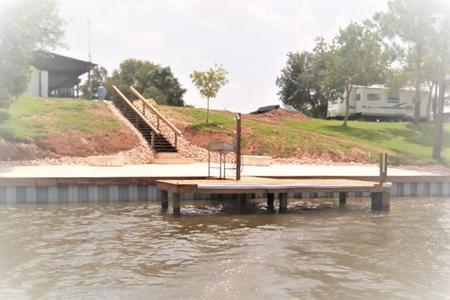
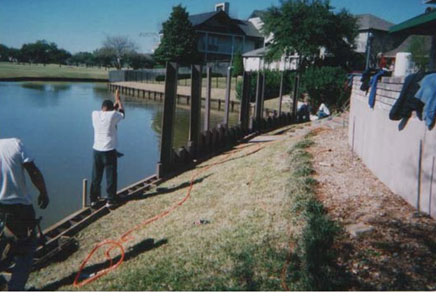
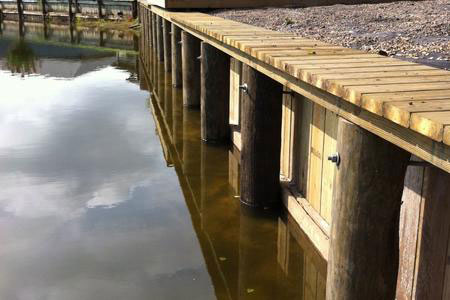
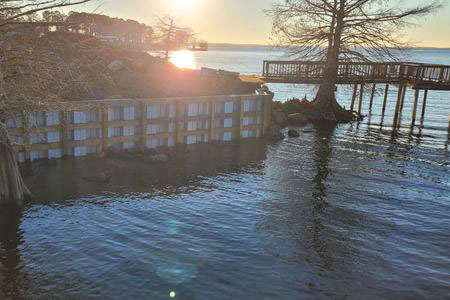
Where We Build Seawall Repair
We build seawall repair for waterfront communities across Greater Houston, Lake Conroe, Lake Livingston, and the Texas Gulf Coast. A few of the areas we serve:
Don't see your area? View all service areas or contact us.
Seawall Repair FAQs
Can my seawall be repaired, or does it need full replacement?
It depends on the cause and extent of the failure. Many seawalls can be repaired with tie-back restoration, void filling, and cap or whaler replacement at a fraction of replacement cost. We assess honestly and only recommend replacement when a wall is truly beyond repair.
What causes seawalls to fail?
The most common causes are failed or corroded tie-backs, loss of backfill through cracks and joints (which creates sinkholes), and built-up hydrostatic pressure behind the wall. We diagnose the root cause before repairing so the problem does not return.
How fast can you respond to a failing seawall?
Active failures and washouts are time-sensitive — we prioritize them. Contact us right away and we will assess and stabilize as quickly as possible to prevent further loss.
Do you repair steel, vinyl, and wood seawalls?
Yes. We repair all three and can transition or replace with the most appropriate material for your shoreline and budget.
How much does seawall repair cost?
Cost depends entirely on the failure mode and extent — tie-back restoration, void filling, and cap replacement are each a fraction of full replacement cost. That's exactly why we diagnose before quoting: the repair that targets the actual cause is almost always the cheapest path that actually lasts. Estimates are free and itemized.
What are the warning signs my seawall is failing?
Depressions or sinkholes in the lawn behind the wall, cracks in the cap, the wall visibly leaning or bowing waterward, gaps opening at panel joints, soil washing out at the toe after rain, and new low spots along patios or walkways near the wall. Any of these justifies an inspection — early-stage repairs are far cheaper than late-stage ones.
How long does a seawall repair take?
Targeted repairs — tie-backs, void filling, cap sections — are typically completed in days once mobilized. Larger stabilizations or partial rebuilds run longer depending on wall length and access. Active failures get priority scheduling and we stabilize first to stop ongoing loss.
Why is my lawn sinking behind my seawall?
Almost certainly washout: soil escaping through joints, cracks, or under the wall's toe into the water, leaving voids that surface as depressions and sinkholes. It won't stop on its own — the flow path enlarges over time. We seal the escape path, fill the voids, and restore drainage so the loss ends.
Will my homeowner's insurance cover seawall repair?
It depends on your policy and the cause — sudden storm damage is treated differently from gradual deterioration. We document conditions and scope clearly, which supports claims where coverage exists. Check your policy's provisions for bulkheads and retaining structures; many exclude them unless specifically added.
Can you repair just a section of my seawall?
Yes, when the failure is localized — one washed-out joint, a damaged panel span, a section of failed cap. We tie the repaired section into the sound wall correctly. If our inspection shows the same failure developing wall-wide, we'll show you the evidence and let you decide between phased repair and comprehensive work.
Is polyurethane foam injection a permanent seawall fix?
Foam and resin injection can seal leaks and fill voids quickly, and it has its place — but on its own it does not restore the structural anchoring that holds a wall plumb. If the tie-backs have failed or the cap is cracked, injecting foam behind the wall just hides the cause for a season. Our repairs treat the structure and the soil together — tie-back and deadman restoration, cap and whaler work, sealed joints, compacted backfill, and drainage — so the fix lasts instead of buying a few months.
Do I need riprap or toe protection with my repair?
If boat wake, waves, or current are washing at the base of your wall, yes — toe scour undermines a wall from below and is a leading cause of sudden leaning after years of stability. A properly sized riprap apron over bedding stone absorbs that energy and stops the erosion. Quiet interior canals often don't need it; open-fetch bayfront and high-traffic locations usually do. We assess it as part of the inspection and size the stone to your site.
How long do vinyl, timber, and concrete seawalls last?
Modern vinyl/PVC sheet piling resists rot and marine borers and can perform 30+ years with proper tie-back design and drainage. Treated timber is economical and, at the correct retention (2.5 CCA for brackish or saltwater, .60 CCA for freshwater), performs well — but degrades faster in brackish water than vinyl. Concrete is durable yet vulnerable at joints and caps without maintenance. We recommend materials based on your wave energy, soils, and how long you want to go between repairs.
What permits does a Lake Houston or coastal seawall repair need?
It depends on the water. Lake Houston bulkhead work typically involves the City of Houston, with possible USACE review and floodplain coordination. Coastal repairs on Galveston Bay and the Gulf can require the USACE Galveston District (Section 10/404) and a Texas GLO joint application; Lake Conroe goes through the SJRA and Lake Livingston through the TRA. We prepare the drawings and applications and coordinate the reviews so your repair stays on schedule.
Can you respond after a storm or hurricane?
Yes. Active failures and storm damage are time-sensitive — a wall that has started to move is on a clock, and every tide and rain accelerates it — so we prioritize them for inspection and stabilization to stop ongoing loss while a permanent repair is scheduled. If you've taken storm damage to a seawall, dock, or lift, contact us right away.
How do I find a good seawall repair contractor near me?
Look for a licensed, insured marine contractor that builds seawalls in more than one material and drives its own piling — that combination means the recommendation is not steered toward the one product a crew carries. Ask whether they diagnose the failure mechanism before quoting, who handles permitting with the controlling authority, and whether the estimate is itemized so you can phase work. We serve Greater Houston, Lake Conroe, Lake Livingston, Clear Lake, Galveston Bay, and the surrounding Gulf Coast communities.
How much does seawall cap repair cost?
It depends on whether the cap is the problem or the symptom. Replacing weathered cap sections on a structurally sound wall is a contained job. If the cap cracked because the wall rotated or lost backfill beneath it, the structural work has to come first or the new cap will crack in the same places. Our inspection determines which situation you are in before we quote, and estimates are free and itemized.
What does seawall maintenance involve?
Keeping weep holes clear so pressure can escape, sealing joints before they start passing soil, addressing depressions behind the wall while they are still small, keeping irrigation and downspout runoff from discharging behind the wall, and monitoring the waterline zone on steel and the cap and whalers on timber. Done annually it is minor work; skipped for a decade it compounds into a rebuild.
Do you offer seawall maintenance agreements for HOAs and marinas?
Yes. For community bulkhead systems and commercial waterfronts we can establish scheduled inspection and maintenance so a board gets predictable budgeting and documented condition tracking rather than emergency assessments after a failure. We currently handle community-scale bulkhead work including a 36-property, 1,300+ linear-foot HOA replacement.
.webp)
Get a Free Seawall Repair Estimate
Tell us about your project and we'll provide a detailed, no-obligation estimate. Serving Greater Houston, Lake Conroe, Lake Livingston, and the Texas Gulf Coast.